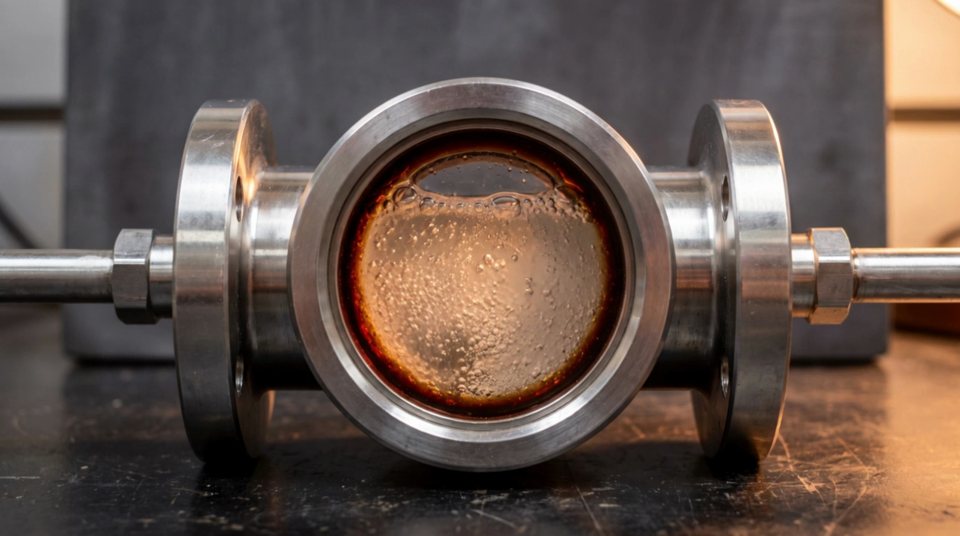
CO2, rich-gas, foam, and hybrid huff-n-puff corefloods on Eagle Ford and Wolfcamp plugs at reservoir temperature and pressure, monitored by time-lapse computed tomography. Combined gas and surfactant recovery reached 57.6% OOIP in a single plug.
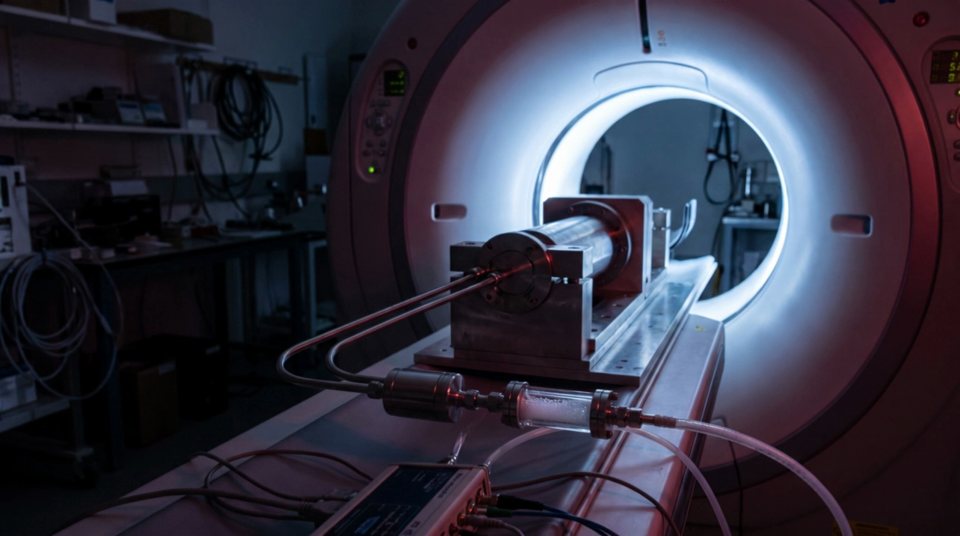
Organic-rich shale formations recover less than 10% of original oil in place under primary depletion. Production declines rapidly, and thousands of wells drilled in formations with high remaining oil saturation present a target for enhanced oil recovery. The Eagle Ford and Wolfcamp campaigns summarized here address that target with gas injection: huff-n-puff corefloods at reservoir temperature and pressure, monitored by time-lapse computed tomography to track fluid movement inside the core plugs.
Recovery in these systems is governed by the interaction between fluids in the fracture network and oil stored in the matrix. Above the minimum miscibility pressure, a multi-contact vaporizing gas drive extracts light and intermediate components from the larger pores, and recovery factor continues to rise with operating pressure beyond the MMP. Surfactant-assisted spontaneous imbibition acts on the smaller pores through wettability alteration and interfacial-tension reduction, and enriched produced gas (50% CH4–50% C2H6) extends the method to fields where CO2 supply or flaring constraints govern. The two mechanisms are complementary, and their combination defines the hybrid scheme.
Loading the three-dimensional scene
Interactive scene requires WebGL.
Miscible — multi-contact
Schematic envelope — Eagle Ford CO2 huff-n-puff17% OOIP
Injected CO2 · sweptMixing zoneOil in placeBypassed oilFront
Miscible — multi-contact · 17% OOIP
Figure 1 — Multi-contact miscible displacement in a core plug, section view. Below the MMP the front is sharp and bypassed oil remains; above it a vaporizing gas drive develops a mixing zone and extraction deepens with pressure. The recovery readout is the schematic Eagle Ford envelope anchored on SPE-191752, not a computed value.
Multi-contact miscibility and the two pore classes
Miscibility develops by contact, not on injection. The injected gas vaporizes light and intermediate components from the oil it meets; the enriched gas moves ahead and contacts fresh oil, and each contact moves the gas composition toward the critical mixture. Above the minimum miscibility pressure the two-phase region has contracted enough for the contact path to reach a single phase, and the displacement becomes piston-like at the front. Below it the path ends on a tie line and the front stays two-phase, leaving bypassed oil behind.
The core plugs carry two pore classes that respond to different agents. Gas extracts oil from the larger pores, where the CT number falls as density falls. Aqueous surfactant solution imbibes counter-currently into the smaller pores under wettability alteration and interfacial-tension reduction, and the CT number rises. The hybrid scheme applies the two agents in sequence to the two classes.
Figure 2 — Vaporizing gas drive on a pseudo-ternary diagram. Successive contacts move the gas composition along the dew-point curve; the two-phase region contracts as pressure rises, and at the MMP the critical tie line passes through the oil composition. Compositions are schematic; the MMP marker is the measured 2,132 psig (SPE-179673).
B
Miscible
Miscible — recovery rising with pressure toward 50% OOIP
3,000
Wolfcamp, JPSE 2021At 5,000 psig the CO2 experiment recovered less oil than lower-pressure experiments — pressure–recovery response is not monotonic at high pressure.
Anchors: MMP 2,132 psig · RF < 5% OOIP below MMP · RF 50% OOIP at 3,500 psig · Eagle Ford CO2 huff-n-puff dataset
Miscible — recovery rising with pressure toward 50% OOIP
Figure 4 — Operating-pressure response of the Eagle Ford CO2 huff-n-puff dataset. Recovery factor stays below 5% OOIP under the MMP of 2,132 psig and rises with operating pressure to 50% OOIP at 3,500 psig.
CT number decrease — gas drains larger poresCT number increase — aqueous imbibition into smaller pores
Light and intermediate components extracted from larger pores — up to 50% OOIP
Figure 3 — Time-lapse CT response during huff-n-puff experiments on Eagle Ford core plugs. Gas injection recovers oil from the larger pores; surfactant solution imbibes counter-currently into the smaller pores, confirmed by NMR (SPE-191502).
02
Projects
Interactive reports
01
Slim tube and huff-n-puff · Interactive report
Miscibility and Operating Pressure
Slim-tube determination of the CO2–crude MMP (2,132 psig, Eagle Ford) using a 20-ft fast-slim-tube protocol, and huff-n-puff corefloods showing that recovery factor continues to increase as operating pressure is raised beyond the MMP — behavior opposite to conventional reservoirs. Operating below the MMP yields recovery factors under 5% OOIP.
Slim-tube, bead-pack, and reservoir-core experiments across immiscible, near-miscible, and miscible conditions isolate the contribution of gravity drainage during CO2 flooding. Vertically stable downward displacement outperformed horizontal displacement, indicating gravity drainage carries greater significance than phase behavior alone.
Wolfcamp core experiments compare methane, ethane-enriched gas, carbon dioxide and foam. Inspect the measured recovery results, then use the composition planner within its stated interpolation range.
CO2 huff-n-puff recovered up to 49% OOIP from Eagle Ford cores; surfactant-assisted spontaneous imbibition added between 5.2 and 11.6 percentage points — including from a plug that had produced under 1% under gas injection — and the maximum combined recovery observed in a single plug was 57.6% OOIP.
Adel, I.A., Tovar, F.D., Zhang, F., and Schechter, D.S. 2018. The Impact of MMP on Recovery Factor During CO2-EOR in Unconventional Liquid Reservoirs. SPE-191752-MS, SPE Annual Technical Conference and Exhibition, Dallas, Texas, 24–26 September.
Adel, I.A., Zhang, F., Bhatnagar, N., and Schechter, D.S. 2018. The Impact of Gas-Assisted Gravity Drainage on Operating Pressure in a Miscible CO2 Flood. SPE-190183-MS, SPE Improved Oil Recovery Conference, Tulsa, Oklahoma, 14–18 April.
Zhang, F., Adel, I.A., Park, K.H., Saputra, I.W.R., and Schechter, D.S. 2018. Enhanced Oil Recovery in Unconventional Liquid Reservoir Using a Combination of CO2 Huff-n-Puff and Surfactant-Assisted Spontaneous Imbibition. SPE-191502-MS, SPE Annual Technical Conference and Exhibition, Dallas, Texas, 24–26 September.
Zhang, F., Adel, I.A., Saputra, I.W.R., Chen, W., and Schechter, D.S. 2019. Numerical Investigation to Understand the Mechanisms of CO2 EOR in Unconventional Liquid Reservoirs. SPE-196019-MS, SPE Annual Technical Conference and Exhibition, Calgary, Alberta, 30 September–2 October.
Zhang, F., and Schechter, D.S. 2021. Gas and Foam Injection with CO2 and Enriched NGL's for Enhanced Oil Recovery in Unconventional Liquid Reservoirs. Journal of Petroleum Science and Engineering 202: 108472.